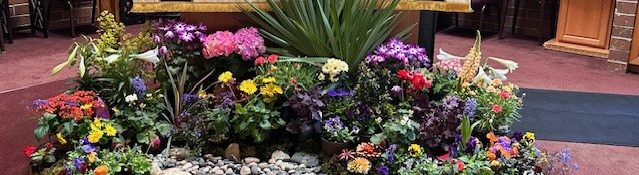

Where you have experienced or witnessed transformation happening at Faith?
By now you’ve heard me preach more than once about the idea that the purpose of a congregation is to gather together the people of God, transform us more and more into the likeness of Christ, and then send us back out into the world to be salt and light and leaven to work that same transformation in the world. And you’ve heard me talk about how that transformation happens reliably in several areas of our common life: in our worship and prayer, in our study and learning, in our life as a community, and in our actions of service.
In the almost nine months I’ve been at Faith, I have seen the Holy Spirit powerfully at work in all of these areas of our congregational life:
Worship and Prayer. Sundays are the heart of our life together, from the joy of the Eucharist to the warm hospitality and family-gathering feeling of coffee hour. Worship and prayer continues in daily Morning Prayer, in Wednesday’s Welcoming and Centering Prayer and our recent evening Eucharists, in the activities that families do together to observe the seasons of the church year, and in our own private prayer.
Action. Our Fresh Start ministry on Mondays is where the heart stirs our hands into action, providing free food, showers, and laundry for our neighbors. But our service continues through the week, as we make our building available to Unity of North Kitsap, a Gamblers Anonymous group, two different Al-Anon gatherings, and the Poulsbo Garden Club.
Study and Learning. Every Tuesday, some of us gather to read and study the Bible together, taking an early look at the texts we’ll be hearing on the following Sunday. Together we watched a series of videos about the Episcopal Church during Lent, and we’re reading How We Learn to Be Brave together now. Our Godly Play program also provides weekly learning opportunities for the youngest among us—a group that is promising to outgrow the space they occupy!
Life in Community. I already mentioned the warmth of our Sunday coffee hour, and I believe that is a key place where the Holy Spirit is at work here. Any time we eat together, talk together, listen to each other—the Spirit is moving and transformation is happening. Think of our barbecue with our friends from Unity, our Wednesday soup supper alongside our book study, the celebration we held for our Renewal of Ministry service in October, and the youth gathering to play Dungeons & Dragons.
Where have you experienced or witnessed this transformation? I hope you’ll reflect on that question and share your stories with me, with members of the Bishop’s Committee, and with the rest of us as we gather in community. We’ll be hearing some of those stories in worship over the next few weeks.
This fall, as we face the task of preparing our church’s budget for 2026, I want to invite you to look at our financial picture through the lens of that transforming work. Our budget reflects our priorities, and it enables and shapes our ministries. We spend money in order to open space for the Holy Spirit to do that work of transformation in and among us!
To choose one easy example, we have about $4,000 penciled into our budget specifically for worship expenses—to pay our organists, to provide altar supplies, and to pay for the legal right to reprint and stream the music we sing together. That’s a pretty small portion of our budget to support a key source of transformation in our congregation—our worship life together.
Looking at a less obvious example, about $26,000 in our budget—nearly a quarter of our annual expenses—goes to the operation and maintenance of our building and grounds. That pays our gas, electric, water, sewer, and trash bills, as well as covering the many maintenance tasks that come up month after month. And that portion of our budget supports every aspect of our life as a congregation—our worship in the nave, our study in the library (and on Zoom), and our fellowship in the parish hall. It also supports our service to the community, including all the programs I outlined above.
Here’s a quick look at the rest of the budget we’ve begun to sketch out for 2026:
Outreach: $1000. This is in addition to money we spend from a designated fund that’s dedicated to the work of Fresh Start, which this year was about $2,600. This additional outreach budget helps us participate in events that increase our visibility in the community (like having a table at Poulsbo Pride and Kitsap Pride, as we did this year). We also use this money to support other worthwhile causes in our region. This is an important extension of our action—not just service to the community, but also evangelism, telling our story of God’s love to a world in desperate need of that good news.
Conferences: $550. This allows us to pay for our delegates to attend the Diocesan convention and for the Bishop’s Committee to have a retreat day with a facilitator from the diocese. Both of these relate to life in community—including our life in the larger community of the diocese.
Parish Life: We have a small parish life budget—in 2025 it was $100. We’d like to increase that to $500, given the importance of the time we spend together in fellowship and community. That will simply allow us to host more events and celebrate together more.
Diocesan Assessment: $14,210. This is based on a percentage of our operating budget and supports the work of the diocesan office in Seattle. It’s an important reminder that we are not just a local church, we are part of a much larger branch of the Jesus Movement—the Diocese of Olympia, the Episcopal Church in the U.S., and the worldwide Anglican Communion.
Operations: $4,760. This is the nitty-gritty stuff that keeps us going week to week. It covers bulletin printing, our internet and telephone, and general supplies, as well as any advertising we might do. Much like our facilities budget, this supports the whole breadth of ministry that happens in this place.
Clergy Expenses: $58,123. This includes a small increase to my pay (from $44,200 to $45,791) and pension, much less money than we spent on supply priests last year ($1,600), and the various other costs associated with having a priest on staff. I remain half-time, targeting 20 hours of work for the church each week alongside my other, full-time job. The church does not provide health insurance for me and my family (that comes from my other job), but our 2025 budget assumed that we would be paying about $12,000 for that. We’ve removed that expense from the 2026 budget.
Our current budget sketch projects total expenses of $109,258—a decrease of almost $15,000 from last year’s budget, thanks in large part to not budgeting for medical insurance. However, that’s an increase of about $4,000 from what we project we will actually spend in 2025.
So where does that money come from?
The short answer is, it comes from you.
The one thing we can be pretty confident about is that we’ll take in about $13,000 in donations from the various other groups that use our building. In 2025, we estimated that we’d also collect about $80,000 in offerings, and it’s looking like we might end the year somewhere above that—which is great.
It’s great because our 2025 budget was a deficit budget. We hoped for $93,000 in income and planned for $124,000 in expenses—a deficit of $31,000. Again, we’ve spent much less than we budgeted for and we’re taking in a little more than we hoped for, so our actual deficit will not be that large. More like about $12,000. Which is not great, but it’s not the end of the world. We have enough money in our operating accounts to absorb that deficit.
There are a few different ways we can approach the 2026 budget:
1) We can make a reasonable guess about how much money we’ll collect in offerings, say $85,000—an increase of $5,000 over last year’s reasonable guess. Given our current sketch for the budget, that would mean planning for a deficit of about $11,000. Again, we can do that for a couple of years, if we have to. But it’s not ideal.
2) We can be wildly hopeful that our actual offerings in 2026 will increase dramatically, say to $96,258. If you add that number to the $13,000 we get from other groups using our building, that equals our projected expenses and behold! We have a balanced budget! The problem, of course, is that it’s not grounded in reality. We have no evidence to suggest that our offerings will increase so dramatically next year.
3) Or we can ask each of you to prayerfully consider how much you can give in the coming year to support the work of transformation that is happening in this place. We can tally up a grand total of those estimates and make a reasonable expectation of our total income for the year, then use that to decide whether or not to run a deficit budget and how big a deficit we can tolerate.
I hope it’s clear that I prefer option 3. When we in the church talk about “pledging” every fall, this is what we mean: asking you to give us some idea of how much income we can expect, so that we can make a budget that’s grounded in reality. It’s not a promise we’re going to hold you to—but if your circumstances change and your giving needs to change as a result (in either direction!), it’s helpful if you let me or our treasurer know.
Right now, the Bishop’s Committee and I are dreaming big. We’re talking about things like hiring a music director, expanding the space we use for Godly Play, expanding our presence at community events, maybe increasing my hours, beautifying our memorial garden, and redoing our landscaping. We believe we are responding faithfully to God’s call and to the work God is doing in this place. And we would love someday for those dreams to become a reality, though we know it will take time.
And we invite you to be part of that dreaming. Please prayerfully consider what you can give to support the wonderful ministry that is happening at Faith—both financially and in terms of your time and talents. We’ll have cards available in the narthex soon where you can write down your estimate of giving and anything else you might want to contribute. We ask that you return a card for your family, perhaps along with a bottle of ruby port wine to use in the Eucharist in the coming year, on Sunday, November 23. That will allow the Bishop’s Committee to plan and finalize our budget in time for our December meeting. If you need a card mailed to your house, let me know; you can also mail your card back to the church in an envelope, addressed to the attention of our treasurer, Louise Kernaghan.
As I said in a sermon in September, when it comes to talking about money in the church, I value transparency, I value your input, and I believe that how we spend our money reflects our values and our priorities. Please don’t hesitate to talk to me or any member of the Bishop’s Committee (Kay, Jeffrey, Kevin, Louise, Paul Q., Paula, and Yori) if you have questions, ideas, or dreams to share.
And thank you for being an indispensable part of the ministry we’re doing together in this place.
The Rev. James Wyatt, Vicar (he/him)
Faith Episcopal Church, Poulsbo
vicar@faithpoulsbo.org
(206) 909-2565